pillar · 12 min read
How to Stop No-Shows in Your Dog Grooming Business (2026)
A groomer's field guide to stopping no-shows before they happen: the reminder cadence, deposits, a waitlist, and the card-on-file backstop that makes it stick.
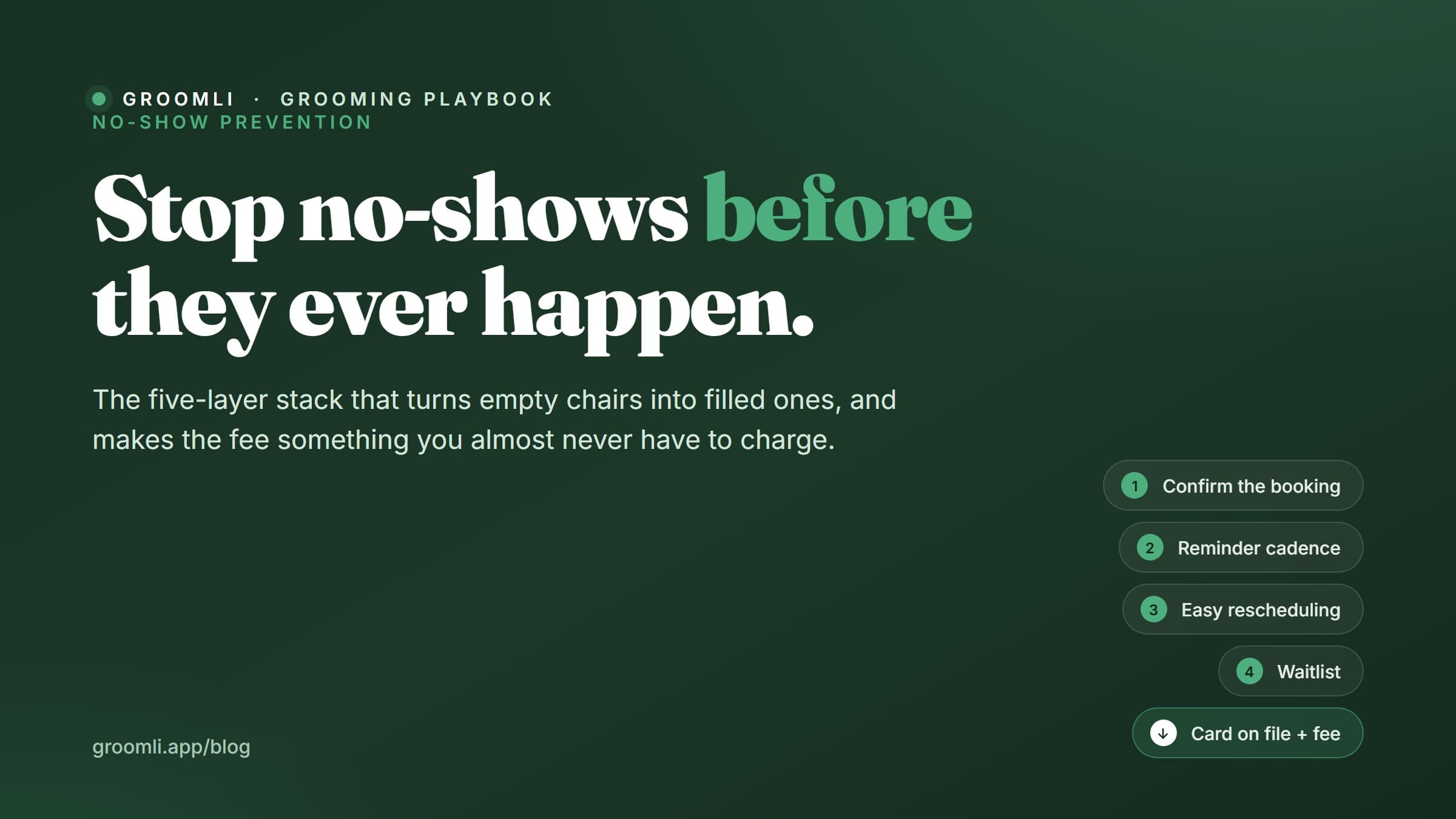
TL;DR. You stop grooming no-shows with a stack, not a single trick. Confirm the booking with a card on file and the policy stated up front, run a reminder cadence at roughly 72h, 24h, and 2h with a "reply YES" ask, keep a waitlist to refill open slots, add deposits for repeat offenders, and back it all with a fee that charges automatically. Prevention shrinks the problem, the fee catches what slips through.
The best no-show I ever had was the one that never happened.
A client (call him Marcus) had booked Rocky, a very large and very unbothered Bernese, for a Saturday full groom. Three hours of work, the kind of slot you build a whole morning around. On Thursday evening my system texted him: "Hi Marcus, Rocky's groom is Saturday 9am. Reply YES to confirm or tap here to reschedule." No reply. Friday morning, still nothing. That silence used to be invisible to me. Now it was a flag.
I texted the top name on my waitlist, a regular who had been asking for an earlier slot for weeks. She took it in four minutes. Saturday at 8:50am Marcus messaged, "So sorry, we're out of town, completely forgot." A year earlier that would have been a three-hour hole and a bad mood. This time the slot was already full, the fee clause was in place, and I barely thought about it.
That is the whole game. Not chasing people after they ghost you. Building a system where the ghost either shows up, tells you early, or pays for the slot they took. I'm Manuel, founder of Groomli. I built the tool because watching solo groomers lose $300 to $500 a week to empty slots made me angry, and most advice on the internet stops at "charge a fee." Charging a fee is the backstop. This guide is about the four layers that sit in front of it, so you charge that fee far less often.
Why do dog grooming clients no-show?
Most grooming no-shows are not malice. They are friction and forgetting. A client books three weeks out, nothing reminds them, life happens, and the appointment falls out of their head entirely. Or they remember but something came up, rescheduling feels awkward, so they go quiet and hope you do not notice. Or, the quiet killer, there was never any commitment attached to the booking in the first place. A free appointment costs nothing to skip.
Hold onto that, because it is the key to the whole system. Every tactic below works by removing one of those causes:
- Forgetting is fixed by reminders.
- Friction is fixed by making rescheduling one tap instead of an awkward phone call.
- No commitment is fixed by a card on file or a deposit, so the booking has weight.
Once you see no-shows as three fixable problems instead of one character flaw in your clients, you stop taking them personally and start engineering them out.
The no-show prevention stack
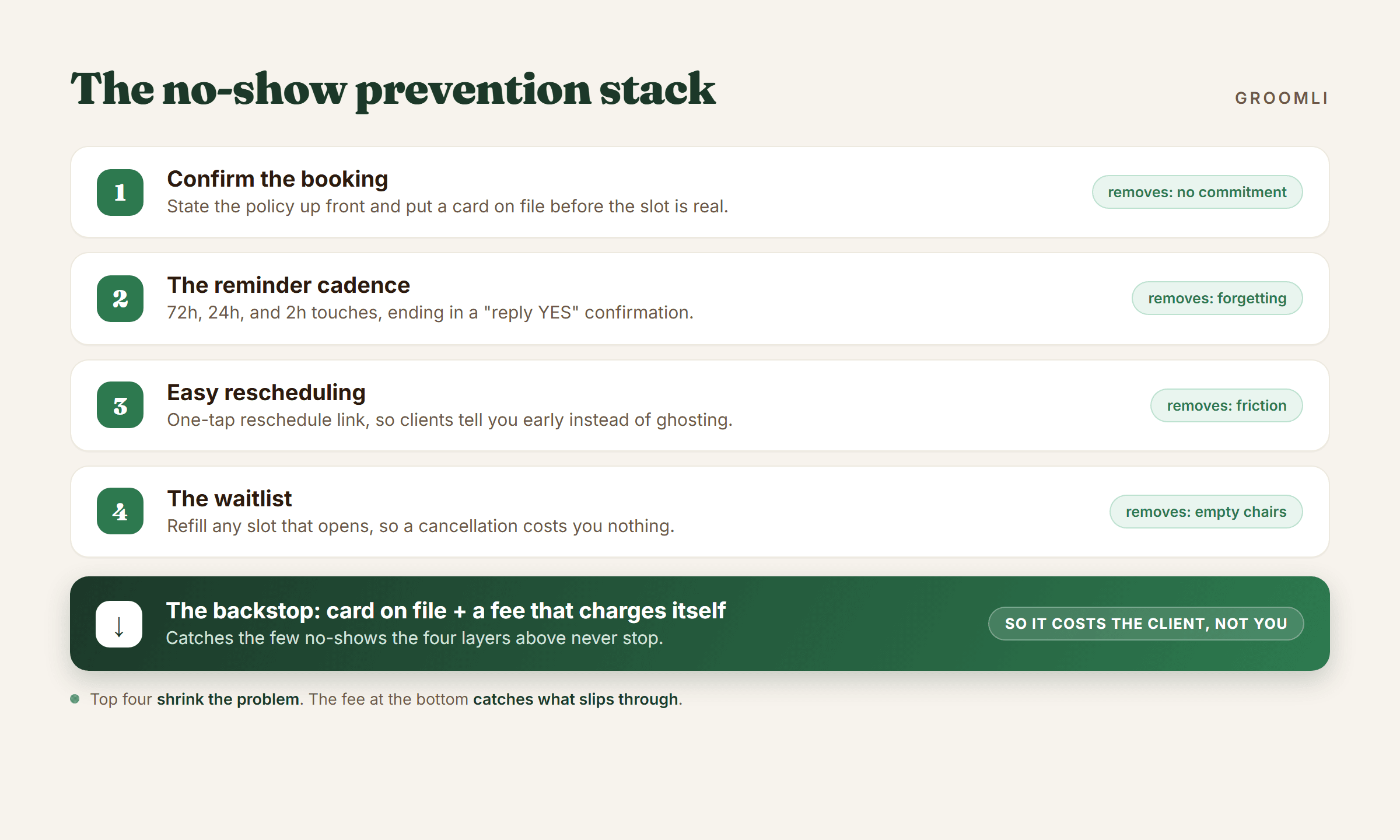
Here is the honest math on why a stack beats any single fix. Reminders alone are strong: a systematic review across healthcare settings found SMS reminders cut non-attendance by around 38 percent on average (Klara, summarizing the study). Strong, but 38 percent is not 90 percent. Deposits alone filter casual bookings but annoy loyal regulars. A fee alone recovers money but does nothing to fill the slot. Stack them and the gaps close.
Five layers, top to bottom:
- Confirmation at booking. Set the policy and put a card on file before the appointment is even on the calendar.
- The reminder cadence. A sequence, not a single text, ending in an active confirmation.
- Easy rescheduling. Make "I need to move it" a one-tap action, so clients tell you early instead of going dark.
- The waitlist. An opened slot gets refilled instead of sitting empty.
- Deposits for repeat offenders. The escalation for the small group who abuse a free booking.
And underneath all five, the backstop: a no-show fee that actually charges. Let's build it layer by layer.
Layer 1: Confirm the booking (and set the terms up front)
The most expensive no-shows are booked into a system that asked the client for nothing. No policy mentioned, no card, no acknowledgment. You have handed them a free option to skip.
Fix it at the source. When a client books, three things should happen before you consider the slot real:
- State the policy in plain language, at the moment of booking, not buried in a service agreement they will never open. One line: "We hold your slot with a card on file. No-shows and late cancellations are charged [your fee]. 24 hours notice to reschedule, no charge."
- Take a card on file. This is the single highest-leverage move in the entire stack, which is why it gets its own section later. A card on file turns a free booking into a committed one without asking the client to pre-pay.
- Get an explicit acknowledgment. A checkbox or a "reply YES to confirm your booking" so there is a record they agreed. This is also what makes the fee enforceable later if you ever need to defend a charge.
Most groomers I talk to skip all three because it feels like friction that might scare off a booking. In practice, the clients a clear policy scares off are the exact ones who were going to ghost you. The policy is a filter, and the filter is doing its job.
See which of the 5 layers your setup is missing. 60 seconds, free.
Take the 60-second check →Layer 2: The reminder cadence that actually works
A single reminder the day before is better than nothing, and it is also leaving most of the win on the table. The pattern that works is a cadence, three touches spaced to catch different failure modes.
Here is the sequence I settled on, and the reasoning behind each one:
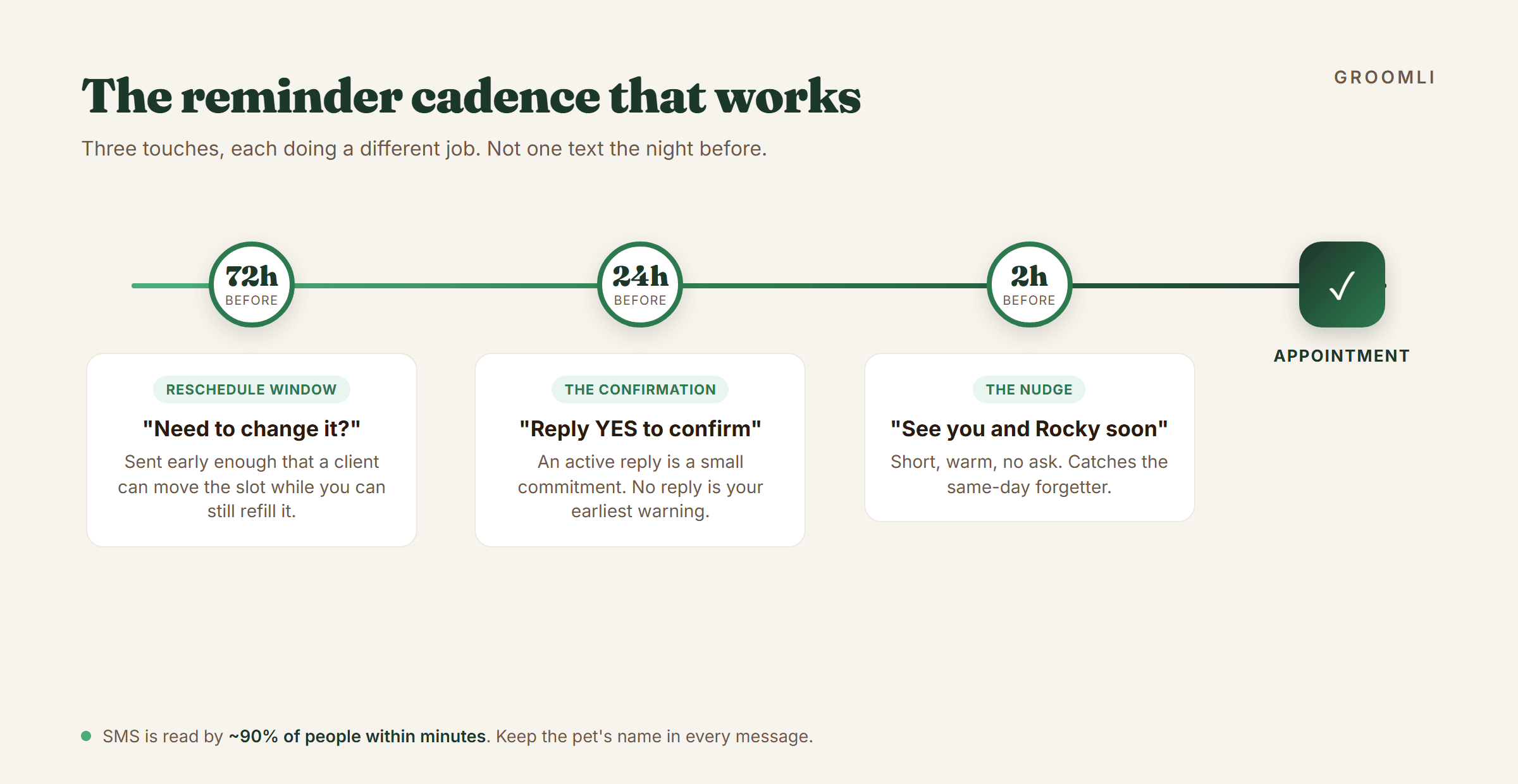
- ~72 hours before, the reschedule window. "Hi [name], [pet]'s groom is [day] at [time]. Need to change it? Tap here to reschedule." Sent this early, a client who cannot make it can move the slot while you still have three days to refill it. This one text is the difference between an empty Saturday and a swapped one.
- ~24 hours before, the confirmation. "Reply YES to confirm [pet]'s appointment tomorrow at [time]." This is the important one. Asking for an active reply converts a passive reminder into a small commitment, and a client who does not reply within 24 hours is your earliest, clearest warning that the slot is at risk. Evening texts confirm at a meaningfully higher rate than midday ones, so aim for around 6pm.
- ~2 hours before, the nudge. "See you and [pet] at [time]. We're ready for you." Short, warm, no ask. This catches the same-day forgetter who confirmed yesterday and then lost track of the morning.
Why three and not one? Because each touch removes a different reason a client fails to show, and layered sequences consistently outperform single reminders. SMS is the right channel for all three: texts are read by roughly 90 percent of people within minutes, far ahead of email (Klara). Keep the pet's name in every message. "Rocky's groom" lands harder than "your appointment."
One caution, so this stays honest: the biggest single-number claims you will see online ("cut no-shows 60 to 80 percent") come from software vendors bundling reminders with deposits, policies, and rebooking all at once. The reminder cadence on its own is worth a real, meaningful chunk. The 60-to-80 number is the whole stack working together, which is exactly the point of this guide.
Layer 3: Make rescheduling effortless
A surprising share of no-shows are just cancellations that never got spoken out loud. The client knew by Thursday they could not make Saturday, but telling you meant a phone call during your work hours, or an awkward text, so they said nothing and let the slot die.
Every bit of friction you remove from rescheduling converts one of those silent no-shows into a clean, early cancellation you can refill. Practically:
- Put a reschedule link in every reminder, so moving an appointment is a tap, not a conversation.
- Frame it as welcome, not a hassle: "Need to move it? No problem, just tap here." You want them to feel that telling you early is the easy, low-guilt option.
- Make the reschedule land on your actual open slots, so it is self-service and you are not playing phone tag.
The goal is simple. You would always rather have a client reschedule than ghost. So make rescheduling the path of least resistance, and fewer of them will choose silence.
Layer 4: Keep a waitlist so slots don't die empty
Prevention will never be perfect. The point of a waitlist is that when a slot does open, whether from an early cancellation or a same-day flake, it does not cost you the revenue. It gets refilled.
You do not need software for the first version of this. You need a list. Keep the names of clients who have said "let me know if anything sooner opens up," and when a slot frees, work down the list by text. Even filling half of your would-be-empty slots dramatically shrinks what no-shows actually cost you, because the loss was never really the missed client, it was the empty chair.
This is why the 72-hour reminder matters so much. An early cancellation gives you days to work the waitlist. A same-day one gives you hours. Both beat an empty morning, but the earlier you know, the more of the slot you recover.
Layer 5: Deposits, for the ones who keep doing it
Deposits work. A small deposit of 20 to 30 dollars, applied to the service on the day, filters out casual bookings because the client now has skin in the game. Grooming operators who introduced deposits have reported new-client no-shows dropping by more than half within six months (ZendPaw).
But deposits have a cost, and honesty matters here: asking a loyal regular of three years to pre-pay can feel like an accusation. So do not blanket-apply them. Use deposits surgically:
- New clients who have no track record with you.
- Repeat offenders who have already no-showed once or twice. "Going forward, I hold your slot with a deposit" is a completely fair response to a second ghost.
- High-value, hard-to-refill slots (the three-hour doodle reset) where an empty chair hurts most.
For everyone else, a card on file gets you most of the commitment of a deposit without asking anyone for money up front, which is why most clients accept it far more readily. Which brings us to the backstop.
The backstop: a card on file and a fee that charges itself
Everything above shrinks the number of no-shows. It never gets it to zero. So the bottom of the stack is the mechanic that makes the whole thing safe: a card on file, and a fee that charges automatically when someone slips through anyway.
Card on file is the quiet workhorse of no-show prevention. It does two jobs at once. It adds commitment at booking (a client who put a card down treats the slot as real), and it makes the fee collectible without you having to chase anyone, send an invoice, or have the confrontation. When a genuine no-show happens, the fee charges. You do not spend a Saturday night deciding whether to send an awkward "you owe me" text, because the system already handled it.
This is exactly the pain Groomli was built for. Card-on-file booking and one-tap (or automatic) no-show charging, without a full salon-management suite you do not want and without skimming a cut off every fee you collect. If the prevention layers above are the offense, this is the clean, boring defense that means a no-show costs the client, not you.
Two things worth reading next, because prevention and enforcement are two halves of the same job:
- If you have not set your fee yet, start with how to charge a pet grooming no-show fee, including the exact policy wording and the fee math.
- If your base prices are shaky (and a shaky price floor quietly makes every no-show hurt more), read what to charge for dog grooming.
Free tool: The No-Show Audit. Answer 5 questions about your current setup and get a report showing exactly which of the five prevention layers you are missing, plus a short plan to close each gap. No email required to see your results. Take the 60-second audit →
What to actually do this week
You do not roll out five layers at once. You stack them in order of leverage. Here is the week-one version:
- Add a card on file to your booking flow. Highest leverage, do it first. This alone changes bookings from free options into committed slots.
- Turn on a 24-hour "reply YES" confirmation text. If you do one reminder, make it this one. The active reply is the signal.
- Write one line of policy and put it at the point of booking. Not a legal essay, one sentence about the card, the fee, and the notice window. If you want it done for you, the free cancellation policy generator spits out the exact wording.
- Start a waitlist today, even if it is just a note on your phone of clients who want in sooner.
Then, over the following weeks, add the 72-hour and 2-hour touches, wire up the reschedule link, and introduce deposits for anyone who ghosts you twice. Prevention is a system you build up, not a switch you flip.
The mindset shift is the whole thing. Stop thinking of no-shows as bad luck you absorb, and start thinking of them as a leak with five specific places to seal. Seal the top four and the fee at the bottom becomes something you almost never have to use. That is the goal. Not a bigger stick, an emptier one.
Frequently asked questions
How do I stop no-shows in my dog grooming business? Stop them with a layered system, not one fix. Confirm every booking with the policy stated up front and a card on file, send a reminder sequence at roughly 72 hours, 24 hours, and 2 hours before, ask the client to reply YES to confirm, keep a waitlist to refill any slot that opens, require a deposit from repeat offenders, and back it all with a no-show fee that charges automatically. Groomers who combine these steps commonly report no-show rates falling from around 10 percent into the low single digits within two months.
Do appointment reminders actually reduce grooming no-shows? Yes. A systematic review across healthcare settings found SMS reminders cut non-attendance by about 38 percent on average, and texts are read by roughly 90 percent of recipients within minutes. A layered sequence beats a single text, because each touch catches a different reason a client would otherwise forget.
Should dog groomers require a deposit to prevent no-shows? Use deposits for new clients and repeat offenders, not for trusted regulars. A small 20 to 30 dollar deposit applied to the service filters out casual bookings, and grooming operators report new-client no-shows dropping by more than half within six months of introducing one. A card on file gets you most of the same commitment without asking for money up front.
What is the best time to send a grooming appointment reminder? Send an early reminder about 72 hours out (so a client can reschedule while you can still refill), a confirmation request the day before (evening texts confirm better than midday), and a short reminder 2 to 4 hours before. Ask them to reply YES. A missing confirmation is your earliest warning to work the waitlist.
Why do grooming clients no-show in the first place? Usually forgetting and friction, not malice. The booking was weeks ago, nothing reminded them, rescheduling felt awkward, or there was no commitment attached to a free slot. Reminders fix forgetting, easy rescheduling fixes friction, and a card on file or deposit adds the commitment a free booking never had.
Kill no-shows without a bloated salon suite. Founding spots are limited.
Claim a founding spot →