pillar · 10 min read
Pet Grooming No-Show Fee: How to Charge It in 2026
Losing $300+ per week to no-shows? Learn how to charge a pet grooming no-show fee that actually works in 2026, plus a free policy generator.
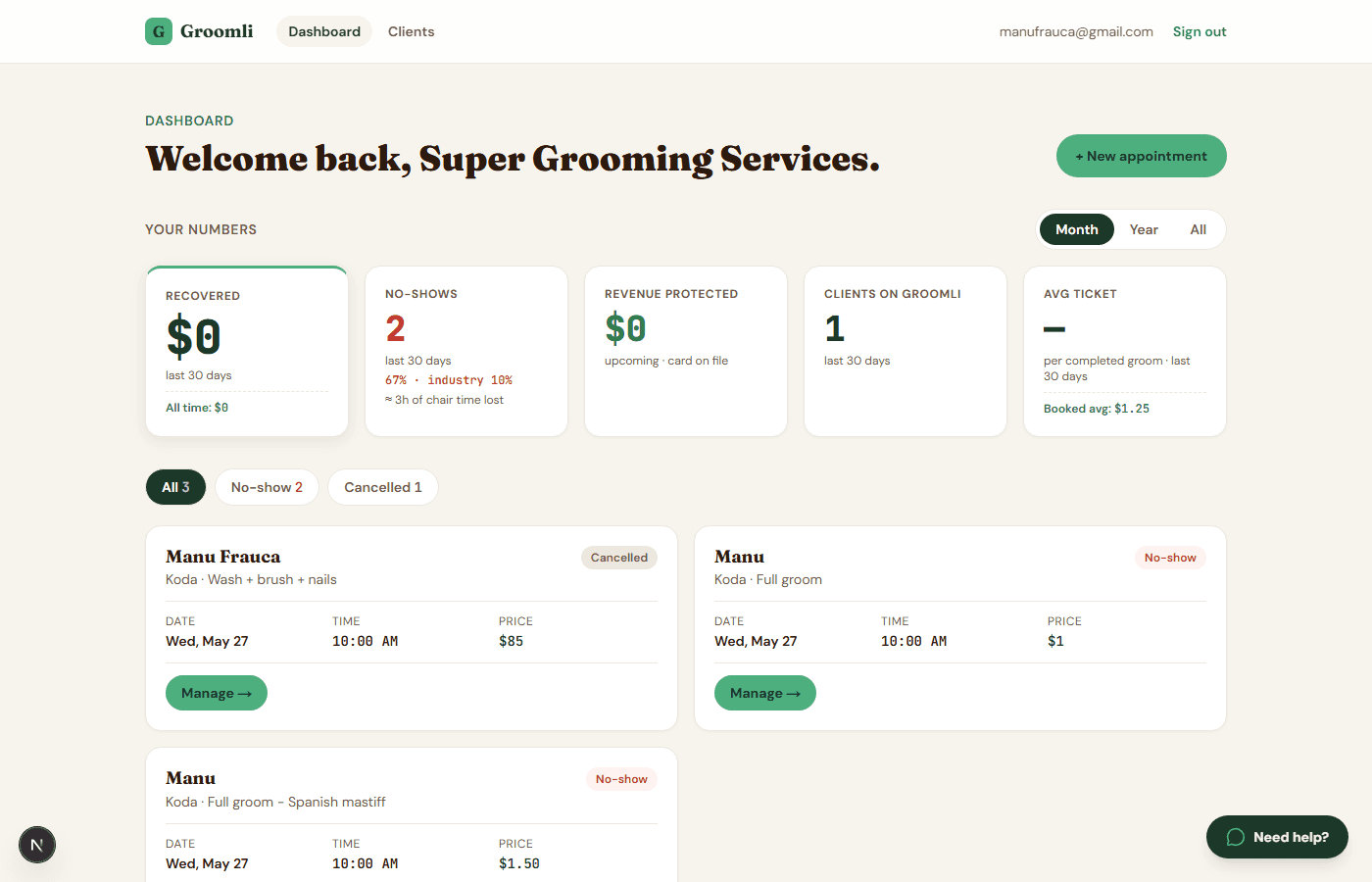
TL;DR. A pet grooming no-show fee is a charge, typically 50% of the service or a flat $25 to $50, that you collect when a client misses an appointment without the agreed notice. Card on file makes it stick. This guide gives you the fee math, the policy wording, and the way to actually collect.
A client (call her Dana) booked Bailey, her standard poodle, for a full groom Saturday March 8th at 10am, my mobile rig parked in her driveway in Astoria. She didn't show. Didn't text. I sat in the van with two clippers warmed up and a $60 hole in the day.
That was the morning I stopped writing polite reminders and started writing a policy. A peer groomer two zip codes over had told me a month earlier, "You have to charge them, Manuel. They don't respect what's free." I'd nodded and ignored her. Bailey's empty slot fixed that.
If you're reading this, you probably just got no-showed too. Or you've been eating the loss for months and a friend finally told you to charge for it. Either way, the question isn't whether you should charge a pet grooming no-show fee in 2026. The question is how to charge it without sounding like a debt collector and without losing the clients who actually deserve a second chance.
I'm Manuel, founder of Groomli. I built the tool because watching solo groomers lose $300 to $500 a week to ghost appointments made me angry, and the existing software was either too expensive, too generic, or quietly skimming a cut off every fee they collected. We don't. More on that later. First, the fee.
What is a pet grooming no-show fee?
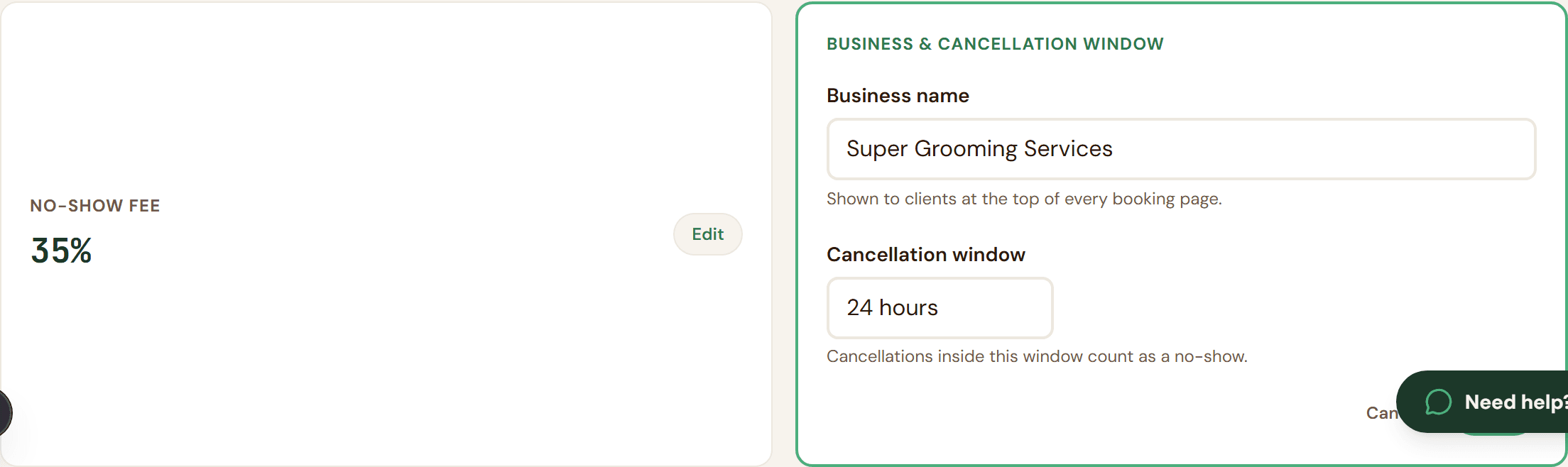
A pet grooming no-show fee is a charge, typically a flat $20 to $50 or 50% of the booked service, that a groomer collects when a client misses a scheduled appointment without giving the agreed advance notice (usually 24 to 48 hours). The fee compensates for the lost time slot and is enforced via a card on file or pre-paid deposit.
That's the definition. Now the part nobody puts in writing: a no-show fee isn't punishment. It's the price of certainty.
Your client is paying for the right to occupy 75 minutes of your day. If they walk away from that right without warning, you charge for the slot the same way a dentist or a hotel would. The fee is a business mechanic, not a moral statement.
There's a distinction worth holding on to. A cancellation fee is what you charge when someone calls inside the notice window. A no-show fee is what you charge when they never call at all. Most groomers I've talked to charge both. The no-show fee is usually equal or higher because ghosting is worse than calling late.
How much should you charge?
The honest answer: enough to cover the slot, not enough to torch the relationship. In conversations with solo groomers across the US, I consistently hear no-show rates of 10 to 20% in any given month. On a $60 average ticket, that's $300 to $500 a week walking out the door before you've picked up a clipper. The fee has to actually move the needle on that number.
Here's what works in the field:
- Flat $25 to $35 for groomers with mostly consistent ticket sizes ($45 to $75 average). Simple to communicate. Easy to defend.
- 50% of the booked service for groomers with wide price ranges ($45 sani-trim up to $150 full-coat doodle). A flat $25 feels light on a $130 groom and absurd on a $50 nail trim. Percentage scales naturally.
- 100% of the service for high-demand books where you turn clients away weekly. This is the "if you ghost me you pay me anyway" tier. Defensible but burns goodwill on first offense.
- $30 minimum clamped underneath any percentage. Below that, the Stripe dispute fee math turns hostile (more on that in section 7).
The JustAnswer legal advice you'll see floating around suggests roughly 1.5× the base appointment fee for variable pricing. That's also reasonable, especially if your shop has a wide spread between a puppy first-groom and a senior doodle reset.
One clarification, since people mix these up: everything here is about the no-show fee, not your base prices. If what you actually need is to sanity-check the grooms themselves, I wrote a separate guide on what to charge for dog grooming and how to find your price floor.
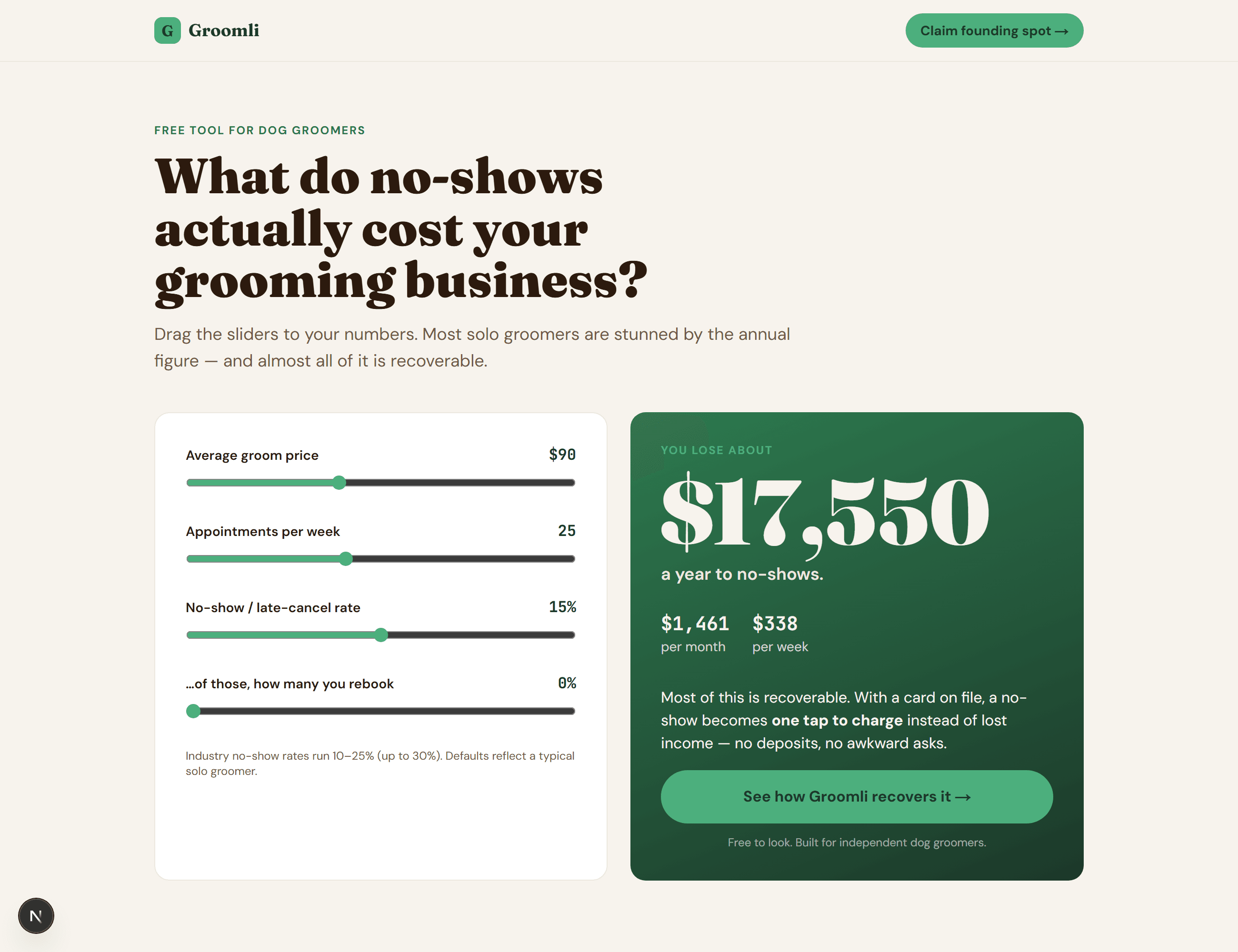
If you want the exact dollar figure for your shop, plug your numbers into our free no-show loss calculator. No email required. The default sliders show a $17,550 annual loss for a typical solo groomer. Your real number is probably worse.
See exactly how much no-shows are costing you this year.
Claim a founding spot →24 hours or 48 hours of notice?
This is the most argued-about decision in the policy. Both work. Pick based on your booking density, not on what feels nice.
Use 48 hours if your book is full and you have a waitlist. The longer window gives you a fighting chance to refill the slot. If someone cancels Wednesday at 3pm for a Friday morning groom, you can text three regulars and probably fill it. Anything under 24 hours, you won't.
Use 24 hours if you're a newer salon, you've still got open slots most weeks, or your client base is mostly working parents who genuinely can't predict their schedules two days out. Shorter notice means lower friction means fewer angry first-time bookers.
A blunt opinion: the industry standard advice of "always 48 hours" is wrong for half the groomers I talk to. If you only fill 60% of your book, demanding 48 hours of notice just means you collect more fees from new clients who then never come back. The fee should protect your time, not chase off the people who would have paid you for actual grooms.
See the 5 gaps in your no-show setup. 60 seconds, free.
Take the 60-second check →Writing the policy
Four templates, in order of strictness. Pick one. Don't write your own from scratch unless you enjoy editing legalese at 11pm.
Template A. Gentle first-offender (recommended for newer salons):
Appointments must be cancelled at least 24 hours in advance. A first missed appointment without notice will receive a written reminder. Any subsequent no-show or late cancellation will be charged 50% of the booked service to the card on file. By booking, you authorize this fee.
Template B. Standard (recommended for most established groomers):
Appointments require 24 hours of cancellation notice. No-shows and late cancellations are charged 50% of the booked service (minimum $30) to the card on file. By booking, you authorize Groomli to process this fee on behalf of [Salon Name].
Template C. Strict (for fully-booked, in-demand shops):
All appointments require 48 hours of cancellation notice. No-shows are charged 100% of the booked service to the card on file. Late cancellations inside the 48-hour window are charged 50%. After two no-shows, future bookings require pre-payment. By booking, you accept these terms.
Template D. Pre-payment only (for waitlisted, high-value books):
All appointments require full pre-payment at booking. Cancellations made 48 hours or more in advance receive a full refund. Cancellations inside the 48-hour window or no-shows forfeit the full service price. By booking, you accept these terms.
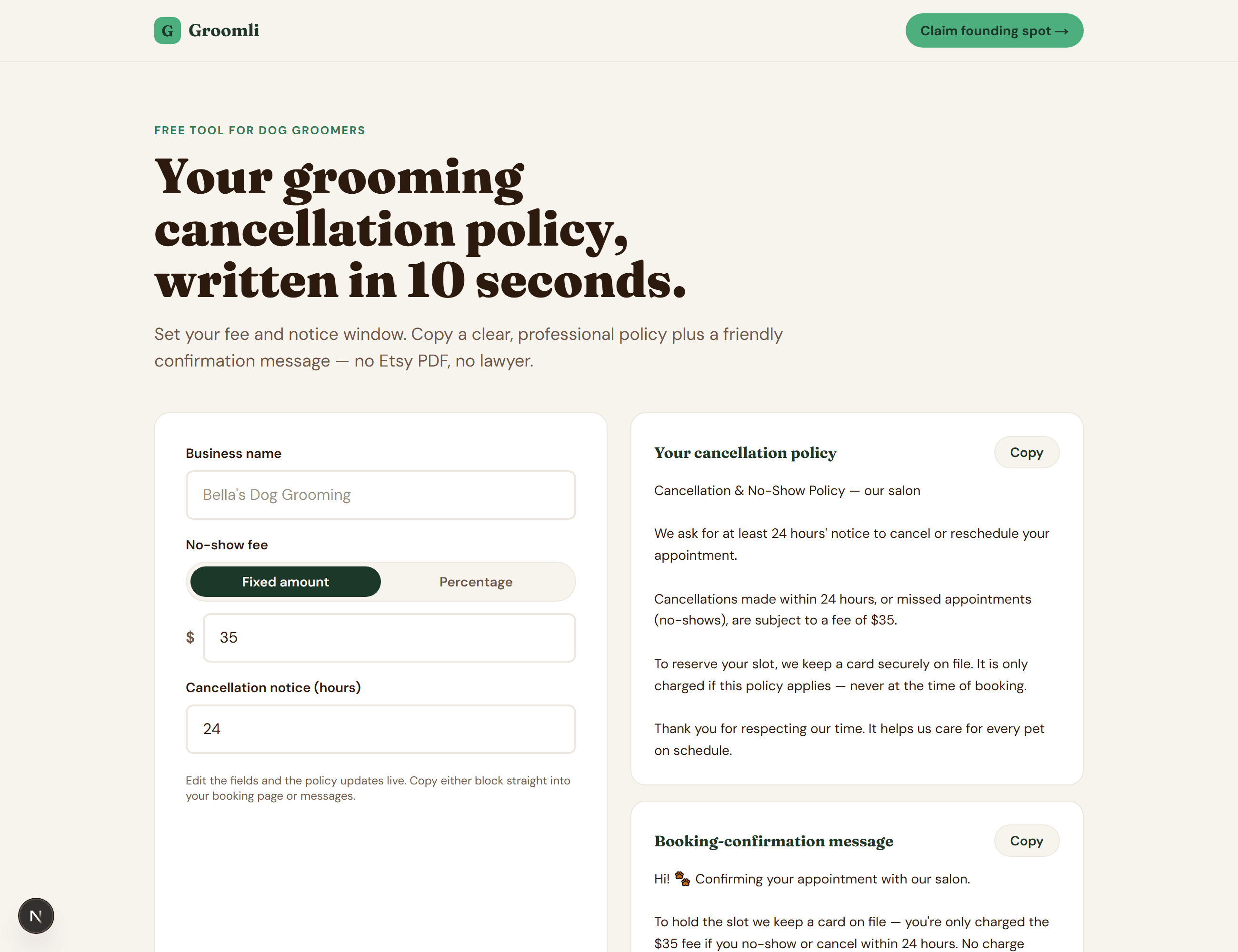
If you want to skip the copy-paste step entirely, our free cancellation policy generator lets you fill in your salon name, fee amount, and notice window and spits out the finished text. It also generates the confirmation-email language, which is the part most groomers forget.
Free tool: The Cancellation Policy Generator. Fill in your salon name, fee amount, and notice window. You get the exact 6-clause cancellation policy that makes fees enforceable, plus the booking-confirmation language and the dispute-proof wording for card-on-file authorizations. Build your free policy →
Card on file or deposit?
Both work. They solve different problems.
A card on file sits in Stripe's vault, tokenized, and gets charged only when you actually tap "Charge no-show fee" in your dashboard. The client doesn't pay anything at booking. They authorize the card and that's it. This is the lowest-friction option and the one I recommend for 95% of solo groomers and small salons.
Collection rates with card-on-file run above 90%. Invoice-after-the-fact runs around 20%. The difference isn't subtle.
A deposit is a real charge taken at booking, usually 25 to 50% of the service. The deposit is then applied to the final invoice if the client shows up, or forfeited if they don't. Deposits are stronger psychologically (the client has actual skin in the game) but they add friction at booking. New-client conversion drops, sometimes by 15 to 20%.
The decision rule: card on file unless you've been burned by repeat offenders or you're in a high-cost service (mobile rig pulling up to a single house, or a $200 full-coat overhaul). For the kennel-cough season walk-in regulars, card on file is plenty.
A note on the mechanics. Groomli uses Stripe Connect Direct Charges, which means the card is tokenized and stored by Stripe (not by me, not by you, not on a clipboard at the front desk). PCI compliance is handled by Stripe. You never see the card number. You can't lose it. You can't get hacked into oblivion over it. This matters legally and operationally.
Can you legally charge a no-show fee?
Yes, in all 50 US states, if you disclose the fee in writing before the appointment is booked and the client agrees. That's the whole rule. Disclosure plus agreement equals enforceable.
The legal doctrine underneath this is called "liquidated damages." Courts allow service businesses to pre-set a reasonable estimate of damages for breach of contract, and a missed grooming appointment is a breach. The fee has to be a reasonable estimate of actual loss. A $200 fee on a $40 nail trim is not reasonable. A $30 fee on a $60 groom is. The closer your fee tracks actual service price, the more defensible it is.
A few state-specific caveats. California consumer protection law requires conspicuous disclosure (not buried in small print). Florida has active consumer protection enforcement, so make sure your policy is visible at the moment of booking, not buried in a confirmation footer. New York has tighter rules around how the fee is presented at the point of booking. Across all three: if the client clicked a checkbox saying "I agree to the cancellation policy" and your policy was visible on that page, you're fine.
What about the matted walk-in who claims they "never agreed to anything"? If your booking flow captured a timestamped acceptance and your confirmation email re-states the policy, the chargeback (and any small-claims case) goes your way. Document the moment of acceptance. The rest is gravy.
How to actually collect (and survive the chargeback)
This is the section nobody else writes. Charging the fee is the easy part. Surviving the chargeback when the client disputes it is where most groomers quit.
Here's the workflow that works:
- Client no-shows. You tap "Charge no-show fee" in the dashboard. Stripe processes against the card on file. Usually settles in 2 business days.
- Client gets the charge on their statement 1 to 3 days later. Some clients call to ask about it. Dana did. She said, "I forgot, I'm so sorry, can you reverse it?" I read her the policy she'd accepted at booking. She paid.
- About 5 to 10% of charged clients will file a dispute with their bank. Stripe charges a $15 dispute fee the moment the dispute is filed (non-refundable). If you choose to contest, Stripe adds a second $15 counter fee (refunded only if you win). Fight and lose, and your total fee exposure on that one dispute is $30. This is why a $30 minimum on percentage-based fees matters. Anything under that, the math eats the win even when you fight and win.
- To win the dispute, you upload evidence to Stripe within 7 days: the signed/accepted policy with timestamp, the booking confirmation email, the appointment reminder logs (2-day, 1-day, 2-hour pings), and a one-paragraph statement of facts. In my own data, response packages built around timestamped acceptance and reminder logs win roughly 7 out of 10 chargebacks; public industry benchmarks for evidence-light cases sit closer to 50%.
The Stripe dispute interface walks you through this. It takes 8 minutes per chargeback. If you skip the evidence upload, you lose by default and the bank keeps the money.
Groomli logs all of this automatically: the timestamped policy acceptance at booking, the reminder send-log, the original confirmation. When a chargeback hits, the evidence package is one click. I built it this way because the manual version is the part most groomers quit at, and the part that turns "I have a policy" into "I actually got paid."
See the 90-second demo of card-on-file fee collection.
Claim a founding spot →Cut no-shows before you have to charge
My favorite fee is the one I never have to charge. In my own data and the conversations I've had with groomers running them, automated reminder sequences reduce no-show rates from 10 to 20% down to roughly 4 to 6% when configured properly. That's most of the no-show problem solved before the fee even matters.
The cadence that works:
- At booking. Confirmation email with appointment time, service, salon address, and the full cancellation policy. This is the legal moment of acceptance, not just a thank-you note. Make it count.
- 2 days before. Email reminder with appointment time, service, and policy re-state. Low pressure. Just a heads up.
- 1 day before. Email plus SMS if you have it. Same content, shorter copy. SMS converts about 3× better than email for short-notice reminders, which is why every modern booking tool defaults to it.
- 2 hours before. SMS only. One sentence. "Hey, see you at 10am for Bailey's full groom. Reply C to cancel."
That last reply-C-to-cancel line is the magic move. Half the no-shows in my data come from clients who realized that morning they couldn't make it but didn't want to call. Give them a one-tap escape and they take it. You get the slot back with notice. They don't get charged. Everyone wins.
Groomli defaults to this 4-touch cadence out of the box. You can also write the policy first using our free cancellation policy generator and paste it into whatever booking tool you're using today.
Not sure which of the 5 gaps you have? 60-second check + 9-day fix plan.
Take the 60-second check →What grooming software actually charges fees?
Honest comparison. No vendor pitch.
| Tool | Monthly cost | Take rate on no-show fees | Card-on-file | Automated reminders |
|---|---|---|---|---|
| Groomli | $29 (founding, locked) / $49 standard | 0% | Yes | 4 (booking/2d/1d/2h) |
| MoeGo | $49+ Basic (SMS included) | 0% | Yes | Multi-channel (SMS/email/phone) |
| Booksy | $29.99 + $20 per staff | 0% | Yes | 2 (limited) |
| Gingr | $109+ ($100+ annual) | Processing markup (contact for rates) | Yes | Yes |
| Square Appointments | Free tier / $49 Plus | 0% | Yes | 1 (limited) |
Each tool's exact processing rate varies. Stripe's standard online rate (which Groomli uses) is 2.9% + $0.30; some tools route through their own payment layer and add a markup. Confirm with each vendor before signing.
The honest line: if you're already on Square Appointments and doing one or two fees a month, stay there. Square is fine. MoeGo and Booksy are full-featured platforms. If you're using everything they ship, the price is fair. The differentiator on a no-show-specific workflow is the take rate: Gingr charges a processing markup above standard interchange on every transaction (including the no-show fees themselves), and the exact rate isn't publicly listed; ask for a written quote before signing. Groomli is 0% on fees because charging you to collect your own money felt wrong.
FAQ
Is it legal to charge a pet grooming no-show fee? Yes, in all 50 US states, as long as you disclose the fee in writing before the appointment is booked and the client agrees. Most groomers collect agreement via a card-on-file authorization at booking.
How much should a pet groomer charge for a no-show fee? Industry standard is 50% of the service price with a $30 minimum (high enough to cover the worst-case $30 Stripe dispute exposure if you fight and lose). Some groomers charge a flat $25 to $50 for missed appointments. The fee should be high enough to cover the lost slot without scaring off legitimate clients.
Do I need card on file to charge a no-show fee? Not technically. You can invoice after the fact. But collection rates jump from roughly 20% (invoice-after) to over 90% (card-on-file) because the charge happens automatically the moment the no-show is confirmed.
What's the difference between a no-show fee and a cancellation fee? A cancellation fee applies when the client cancels within a stated window (typically 24 to 48 hours) before the appointment. A no-show fee applies when the client never cancels and simply doesn't show up. Most groomers charge both, with the no-show fee being equal or higher.
Should the first no-show be free? Up to you. About half the groomers I talk to give one free pass on the assumption that "life happens." The other half charge from day one because they got burned too many times by "first-time" no-shows who never came back. If your book is full, charge from day one. If you're still building, the free pass is reasonable.
What if the client disputes the charge? Upload the evidence package to Stripe within 7 days: the timestamped policy acceptance, the booking confirmation, the reminder logs, and a one-paragraph statement of facts. In my own data, response packages with this evidence win roughly 7 out of 10 chargebacks (public industry benchmarks for evidence-light cases sit closer to 50%). Anything under a $30 fee isn't worth defending because Stripe charges $15 the moment a dispute is filed (non-refundable) plus another $15 if you contest and lose. $30 of fee exposure on a single dispute is the floor.
Stop writing policies. Start collecting.
I built Groomli because every solo groomer I talked to had the same story. Good policy. Card on file. Zero way to actually charge the fee without an awkward phone call or a manual Stripe invoice that the client ignored. The mechanic was missing.
If you want the mechanic: the founding tier is $29 a month, locked forever, 25 spots, 30-day money back. Card on file at booking. One tap to charge when they no-show. 0% take rate on every fee you collect. That last part isn't a marketing line. It's the part that pays for itself.
Questions? hello@groomli.app. I read every email.