pillar · 12 min read
Why Your Pet Grooming Business Isn't Making Money (Booked Solid but Broke)
Fully booked but broke? Here are the 7 places a pet grooming business quietly loses money, the per-slot math to find your number, and the cheapest leak to plug first.
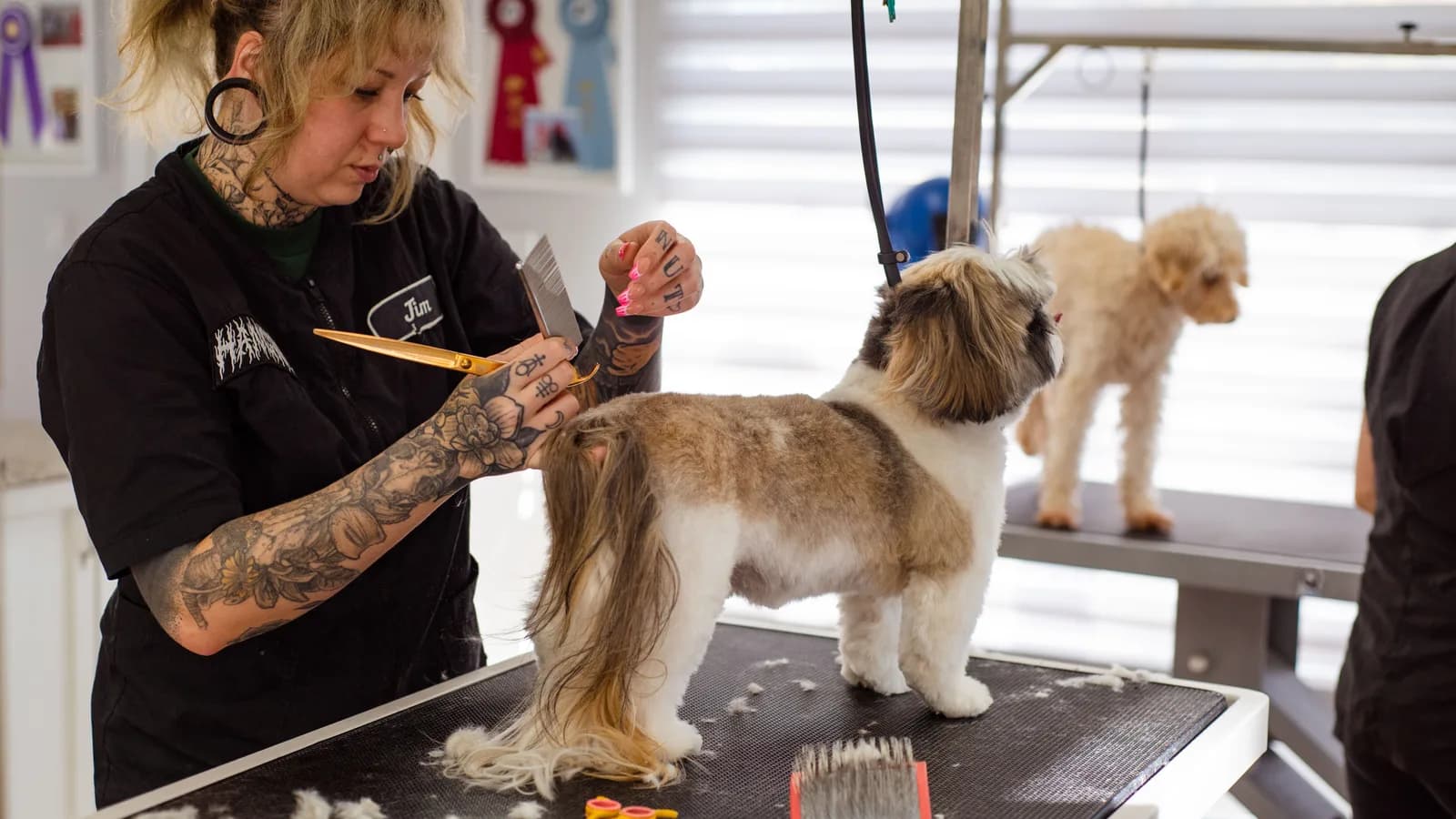
TL;DR. A full pet grooming book measures demand, not profit. Your money leaks in seven specific places: undercharging, free add-ons, unpaid overrun on long dogs, supply creep, fixed costs nobody assigns per dog, gap days, and the quietest one, slots that earned zero because the dog never showed. The last leak is the cheapest to fix because it needs no price increase and no new clients. Put a dollar figure on it here.
I spent a slow Tuesday afternoon last winter doing something my groomer had never had time to do. I opened a spreadsheet and added up one full week of her book, line by line, the way I debug code when a number looks wrong.
She kept telling me she was slammed. Six dogs a day, five days a week, barely a gap on the calendar. On paper that is a healthy little business. She also kept telling me she was broke. Both things were true at the same time, and nobody had ever shown her why.
I'm Manuel, the founder of Groomli. I'm an engineer, not a groomer, so I came at her book the only way I know how: subtract everything that is real until you reach the number that actually lands in her account. The rate was not the problem. The problem was that "fully booked" and "getting paid" were two different numbers, and the gap between them was wider than she thought. Koda, my Spanish Mastiff mix, slept under the desk the whole time.
This post is that spreadsheet, written out. If you are busy and still broke, you are not bad at your job. You almost certainly have a few of these seven leaks running at once.
In this guide
- Why a full pet grooming book can still lose money
- The profit number nobody can honestly hand you
- The 7 places a pet groomer's money actually leaks
- Your real hourly rate is lower than your price list
- Mobile groomers: the leak is worse on the van
- Which leak to plug first this week
- Frequently asked questions
Why a full pet grooming book can still lose money
A full book tells you one thing: people want what you do. That is demand, and demand is good. It is not profit. Profit is decided one slot at a time, after you subtract supplies, the fixed costs of being open, the grooms that run long for free, and the slots that collected nothing because the dog never came.
Here is the part that surprised my groomer. The grooming trade is not short on demand. The US pet grooming and boarding industry runs around 193,000 businesses and has grown roughly 7 to 8% a year over 2021 to 2026 (IBISWorld, 2026). A "broke" groomer with a full calendar is almost never facing a demand problem. They are facing a margin problem, which is a different and far more fixable thing.
The trap is that "busy" feels like "winning." You leave the salon exhausted, the book looks full next week too, and the bank balance does not move. Busy is the feeling. The slot-by-slot math is the truth, and the two come apart quietly over months.
The profit number nobody can honestly hand you
Before the leaks, let me kill a question you have probably Googled: what is a normal profit margin for a pet grooming business?
I went looking for a real answer for this post and I want to be straight with you: there isn't a trustworthy public one. The figures you will find (10%, 20%, "30 to 40% for an established salon", "60 to 80% for mobile") all trace back to marketing blogs with no primary source, and they contradict each other by a factor of four. IBISWorld does publish a real benchmark, but it sits behind a paywall. So anyone handing you a confident margin percentage for free is guessing.
What we do have is honest and a little grim. The US Bureau of Labor Statistics does not even track "groomer" as its own job. Groomers get folded into the broad "Animal Caretakers" category, whose median wage was $33,470 a year in May 2024, with the top 10% still under $46,480 (BLS Occupational Outlook Handbook, 2024). That bucket includes kennel and daycare staff, so skilled groomers sit above it, but it sets the gravity of the trade: this is not a high-margin business by default. You make it one on purpose.
And if you are self-employed, the gap between what you charge and what you keep is wider than an employee's, because you pay the 15.3% self-employment tax (Social Security plus Medicare) that a W-2 groomer splits with an employer (IRS, 2024). Gross revenue is not take-home. Nobody's is.
So forget the internet's average. The only margin that matters is yours, and you get it by finding your leaks.
The 7 places a pet groomer's money actually leaks
I ordered these from the one most people overlook to the one that is cheapest to fix. Every dollar figure below is from the one book I actually added up (a roughly $60 average ticket, six dogs a day), so treat them as a worked example, not a survey. Your numbers will differ. The point is the method.
| # | The leak | Why it bleeds | The fix |
|---|---|---|---|
| 1 | Undercharging with no price-by-coat | One flat price for a 45-min terrier and a 2.5-hr doodle | Price by size and coat, not by service name |
| 2 | Add-ons given away | Nails, teeth, de-shed, gland thrown in "to be nice" | List them, price them, ring them up |
| 3 | Unpaid overrun | The matted or anxious dog that runs 40 min long for free | A matting or handling surcharge, quoted up front |
| 4 | Supply creep | Shampoo, conditioner, blades, consumables | Track cost per dog; review prices yearly |
| 5 | Fixed costs not assigned per dog | Rent or booth, insurance, van payment | Divide monthly fixed cost by dogs groomed; bake it into price |
| 6 | Gap days and low utilization | Empty mid-week slots you never refill | Build a waitlist and a rebooking habit |
| 7 | The slot that earned $0 | A reserved slot the dog never showed for | Card on file plus reminders, so booked time shows up |
Leak 1: undercharging with no price-by-coat structure. This is the big one. If a quick small-dog tidy and a two-hour-plus doodle cost the client the same, the doodle is subsidized by the terrier and you are working the hardest grooms at a loss. Price by size and coat condition. If you are not sure where to start, I broke down what to charge for dog grooming and how to find your floor in a separate guide.
Leak 2: add-ons you give away. Nail trims, teeth, de-shedding, gland expression. Each one is a few minutes and a real cost, and "I just include it" across thirty dogs a week is a paycheck you handed back.
Leak 3: the unpaid overrun on project dogs. The matted rescue and the wriggly puppy do not take 50 minutes, they take 90. If your price assumes 50, every long dog is unpaid labor. A handling or matting surcharge, said out loud at drop-off, fixes it.
Leak 4: supply creep. Real but small. As a checkpoint, grooming educator Carol Visser, writing for PetEdge (2023), worked out shampoo at roughly $2 per dog. The leak here is rarely the shampoo itself, it is never raising prices as your costs do.
Leak 5: fixed costs nobody assigns per dog. Rent or booth split, insurance, a van payment. These do not feel like a per-dog cost, so they get ignored until the month ends. Take your monthly fixed costs, divide by the dogs you groom, and you will see the silent number every groom has to clear before you earn a cent.
Leak 6: gap days and low utilization. A productive groomer can do six to eight low-maintenance dogs a day (more on that below). The mid-week afternoon with two empty slots is capacity you paid rent on and sold nothing from.
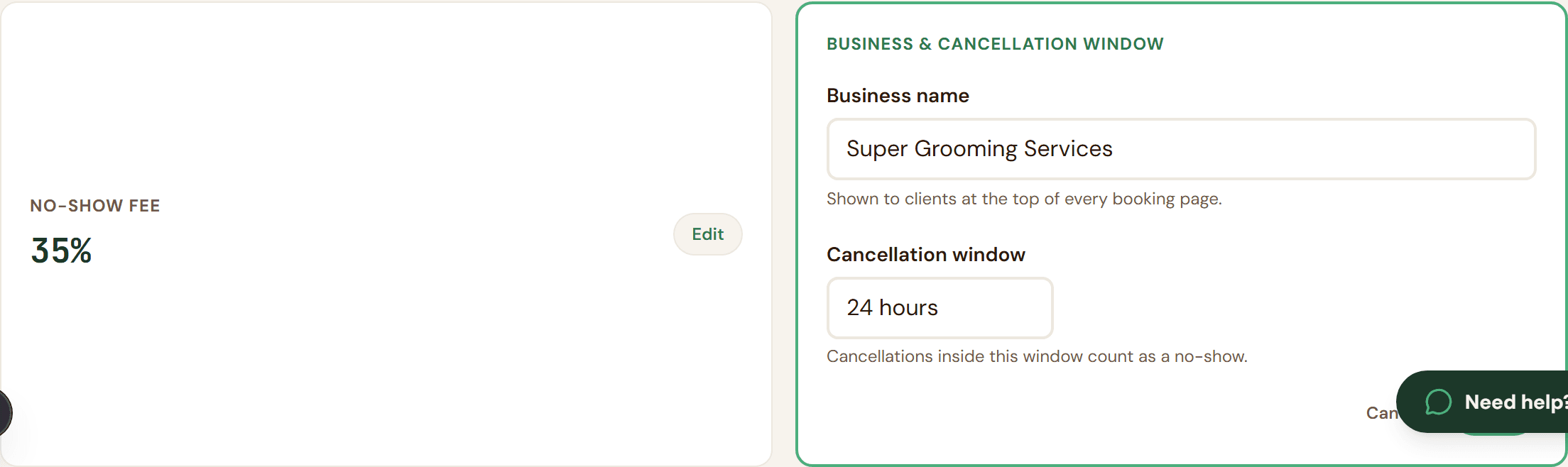
Leak 7: the slot that earned $0. Here is the quiet one. A no-show is not a missed ticket, it is a reserved slot that earned zero while still costing you the rent, the gas, and the clients you turned away to hold it. On my groomer's book, three ghosted slots a week ran $300 to $500 a week straight out the door. That is the leak you can plug without raising a single price or finding a single new client, so before you touch anything else, put a real dollar figure on your own no-show leak with the free calculator. No email needed.
Your real hourly rate is lower than your price list
Here is the math nobody runs on themselves, and it is the one that changes how you price.
Take a $60 full groom that takes 90 minutes door to door. That looks like $40 an hour. Now subtract the real stuff. A couple of dollars of supplies. The setup and cleanup between dogs. The one groom in your day that ran long for free. And the slots that did not pay at all: at a 15% rate of gaps and no-shows, roughly one slot in seven collected nothing, which drags the average down across every other dog you did.
Run that and the $40-an-hour groom is closer to $30, sometimes less. The price list is your best case. Your effective hourly rate, the revenue you actually earn per available hour, is what is left after the gaps.
This is why two groomers charging the same prices, equally busy, take home very different money. One protects their hours. The other lets the gaps quietly reset the rate they worked so hard to set. If you want to see exactly what your gaps and no-shows are shaving off your year, the calculator runs that subtraction on your own numbers in about 90 seconds.
Mobile groomers: the leak is worse on the van
If you run a van, every leak above hits harder, because a mobile no-show is not one dead slot. You drove to the address, you burned the fuel, and the next stop cannot simply move up to fill the hole. The day's margin collapses with nothing to backfill it, the way a salon can sometimes take a walk-in.
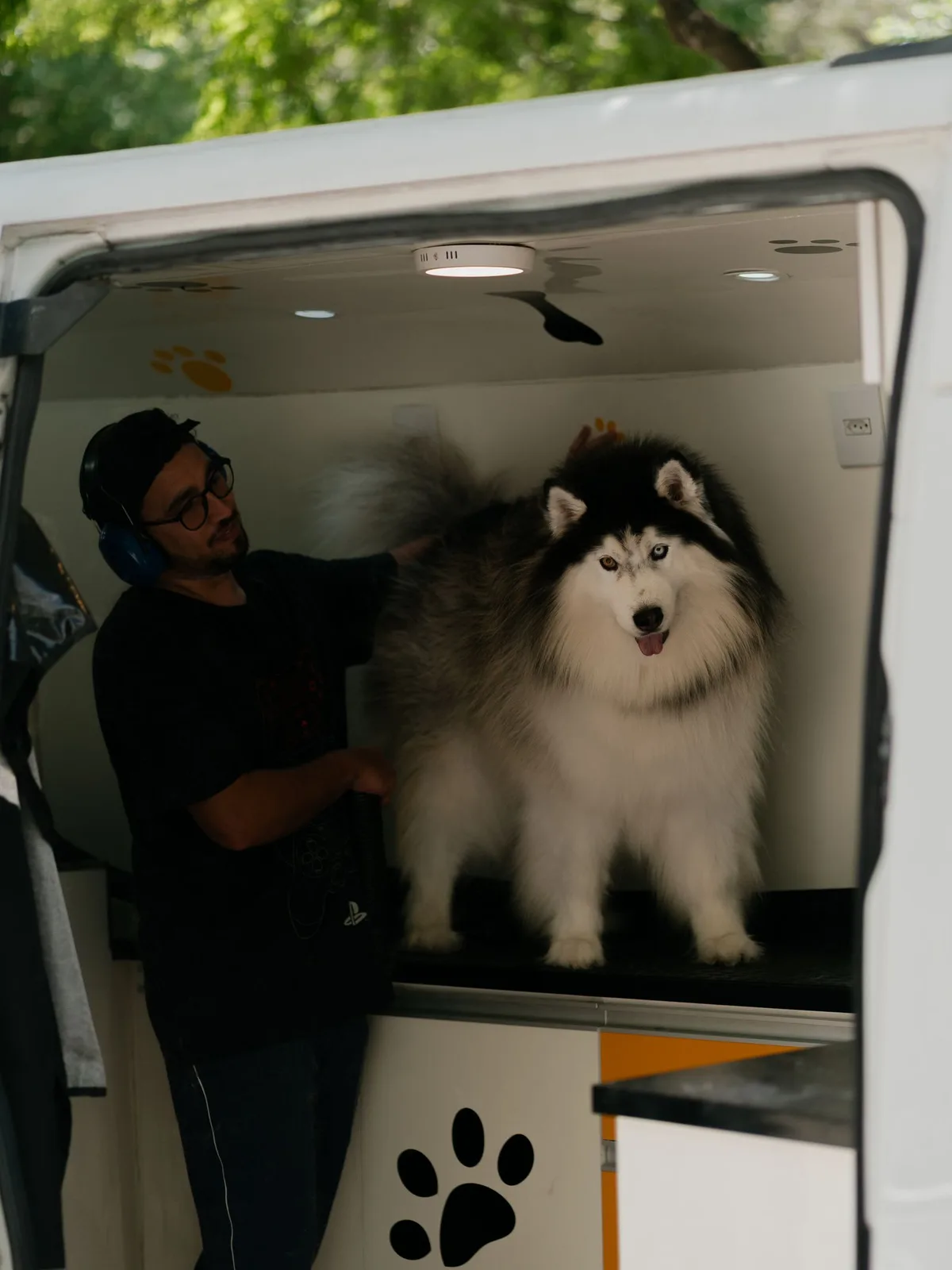
Mobile also carries a cost line salons skip. According to Insureon (2025), a mobile pet groomer pays a median of about $245 a month for commercial auto insurance on top of the coverages a salon carries, while a salon groomer pays none of that. Here is how the two stack up on the policies most groomers carry:
| Coverage (median monthly) | Salon groomer | Mobile groomer |
|---|---|---|
| Business Owner's Policy | $80 | $80 |
| General liability | $50 | $65 |
| Commercial auto | none | $245 |
Source: Insureon, 2025 (median cost for pet groomers who request quotes; your number depends on your history and state).
That commercial-auto line is a fixed cost that has to be earned back across your stops every month. A ghosted stop does not just lose the groom, it loses a slice of the day's fuel and the overhead you were driving to cover. On a van, the empty-slot leak is the first one I would close.
Which leak to plug first this week
You cannot fix seven things at once, so triage by effort against payback.
The pricing leaks (1 through 5) are where most of your money is, and they are worth a real pass over the next quarter. But they are slow. They need new menus, a fresh conversation with every regular, and the nerve to say a higher number out loud. That is a project, not a Tuesday.
The fastest dollar you will recover this week is leak 7, the slots that earn zero. It needs no price increase, no awkward raise-the-rate talk, and no new clients. It only needs your already-booked time to actually show up. Two things do that: reminders, and a card on file so the booking means something.
The data on reminders is strong, even though most of it comes from medical clinics rather than grooming: a 2008 study in BMC Ophthalmology found SMS reminders cut missed appointments by about 38%, and a 2017 pediatric trial cut no-shows from 38% to 23.5% with texts. Reminders catch the honest forgetters. A card on file handles the rest, and it turns a no-show from a write-off into a quick decision you actually control.
There is a difference worth holding onto here. Prevention (reminders and a card on file) is about making the booked slot show up. A no-show fee is about what you charge when it does not. This post is about the first one. If you want the second one, I wrote a full guide to how to charge a pet grooming no-show fee and a shorter step-by-step on actually collecting it, plus a free cancellation policy you can copy and paste.
Frequently asked questions
Why is my pet grooming business not making money even though I'm fully booked?
A full book measures demand, not profit. Profit is decided slot by slot after supplies, fixed costs, the grooms that run long for free, and the slots that earned zero because the dog never showed. A schedule can be full and still lose money if the price per slot does not clear those costs, or if a chunk of slots collect nothing at all.
What is a normal profit margin for a pet grooming business?
There is no reliable public margin figure for grooming. The numbers floating around (anywhere from 10% to 45%) come from marketing blogs with no primary source and they contradict each other. The honest move is to ignore the internet's average and calculate your own: revenue minus supplies, fixed costs, unpaid overrun, and dead slots, divided by the hours you actually work.
How do I know if I'm undercharging for dog grooming?
Convert one groom into a real hourly rate. Take the price, subtract supplies for that dog, and divide by the door-to-door time including bath, dry, haircut, and cleanup. If a 90-minute groom nets less than you would accept per hour doing anything else, you are undercharging, and charging the same flat price for a 45-minute terrier and a 2.5-hour doodle guarantees it.
How much does one no-show actually cost a groomer?
More than the missed ticket. A no-show is a reserved slot that earned zero while still costing you the rent, the gas, and the time you turned other clients away for. On a $60 average ticket, a groomer losing three slots a week is out $300 to $500 a week before counting the slots that ran long. You can put your own yearly figure on it with a no-show calculator.
What is my real hourly rate as a pet groomer?
It is revenue per available hour, not your sticker price. A $60 groom in 90 minutes looks like about $40 an hour, but once you subtract supplies, unpaid overrun, and a 15% rate of gaps and no-shows, the effective number drops well below the menu. The price list is the best case; your real rate is what survives the gaps.
How many dogs should a pet groomer do in a day?
Industry educator Melissa Verplank of Paragon School of Pet Grooming puts the productive minimum at six to eight dogs a day for low-maintenance small to medium haircuts, with a full groom taking 45 to 60 minutes. A book full of large doodles at two to two and a half hours each does far fewer, which is why two equally busy groomers can take home very different money.
| Dog and coat | Time per full groom | Realistic dogs per day |
|---|---|---|
| Low-maintenance small to medium | 45 to 60 minutes | 6 to 8 |
| Large, heavily coated (doodle) | 2 to 2.5 hours | 3 to 4 |
| With a dedicated bather/assistant | varies | more, record days hit 16 to 17 |
Source: Melissa Verplank, Paragon School of Pet Grooming, 2024.